
Search The Internet For The Answer...

Showing posts with label Prevention. Show all posts

Sunday, May 1, 2011

National Arson Awareness Week 2011


National Arson Awareness Week is traditionally observed the first week in May, and this year's theme is “Working Together to Extinguish Serial Arson.”

The goal of this year's Arson Awareness Week is to zero in on the horrific crime of arson, and to use the week of May 1st to the 7th to focus public attention on serial arsonists and provide law enforcement, fire and emergency service departments and communities with tools and tactics to prevent arson in their cities and towns.

This week being Nation Arson Awareness Week everyone should be aware of the growing problem of arson and it is urged that all should get involved in community efforts to combat this crime that threatens their safety and well-being. Prevention is the best way for all to be protected with ongoing efforts this week to raise citizen awareness of the arson problem and increase communi

ty involvement which will go a long way toward saving lives and property.

Communities can start with a neighborhood watch program to create heightened public awareness of the arson problem and to act as a deterrent to arson crimes by working with local fire, police and code enfor cement to recognize and report unusual activities. Arson can be reduced by having an involved and informed community working together with the fire service and law enforcement.

Here in New York State a call to action came as Governor Andrew M. Cuomo proclaimed Sunday, May 1, through Saturday, May 7, as Arson Awareness Week in New York State. A copy of that proclamation is below wit a link to the PDF file to view.
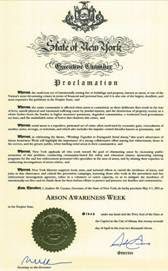


Governor Cuomo Proclamation


According to the U.S. Fire Administration's National Fire Incident Reporting System data, from 2004 to 2006 an estimated 210,300 intentionally set fires occurred each year in the United States. Intentionally set fires account for 13 percent of fires responded to by fire departments across the nation. These fires resulted in an average of approximately 375 deaths, 1,300 injuries and more than $1 billion in property loss each year.

Arson robs communities of its valuable assets — lives and property, Arson destroys more than buildings, it can devastate a community resulting in the decline of the neighborhood through increased insurance premiums, loss of business revenue, and a decrease in property values.”

Steps that can reduce incidents of arson include:

* Contact your local fire or police department if you know or suspect an arson crime.

* Report suspicious activity near houses or other buildings to your local fire or police department, or call 911.

* Support Neighbourhood Watch programs.

* Keep leaves and flammable debris away from buildings. Don't make it easy for an arsonist to start a fire or facilitate a fire's spread to adjacent buildings.

* If you see something, say something.

The Bureau of Alcohol, Tobacco, Firearms and Explosives (ATF) reports that from 2009 - 2010 there were 88 reported serial arson incidents with an aggregate monetary loss of $4.8 million. Arson in residential dwellings accounted for 49 percent of these incidents.

U.S. Fire Administration’s Arson Awareness Week web page www.usfa.fema.gov/aaw/ has information on neighborhood watch strategies, a new report on Motive-Based Offenders, Analysis of Serial Arsonists, joint fire and police teams and task forces, resources for fire investigators and information on witness-driven investigation protocols.

The United States Fire Administration recommends everyone should have a comprehensive fire protection plan that includes smoke alarms, residential sprinklers, and practicing a home fire escape plan.


(The usual disclaimers: I am not a journalist; This isa blog that expresses an outlook and is not conclusive in any shape or manner.)


Thursday, April 7, 2011

USFA Announces the 2011 Arson Awareness Week Theme


U.S. Fire Administration Press Release:

The United States Fire Administration (USFA) is pleased to partner with the International Association of Arson Investigators; Bureau of Alcohol, Tobacco, Firearms and Explosives; USAonWatch; National Association of State Fire Marshals; National Volunteer Fire Council; and the Insurance Committee for Arson Control to announce the theme for the 2011 Arson Awareness Week: Working Together to Extinguish Serial Arson. USFA and its partners will use the week of May 1st to the 7th to focus public attention on the value of a collaborative effort with law enforcement, fire and emergency service departments, and the community to battle serial arsonists.

The goal for this year’s Arson Awareness Week (AAW) is to focus attention on serial arsonists and provide law enforcement, the fire service, and communities with tools and tactics to prevent arson in their city and towns. “A serial arsonist can paralyze a community with fear,” said Glenn Gaines, Deputy United States Fire Administrator. “Each fire feels like a personal assault. Banding together as partners strengthens our resolve and can bring law enforcement, the fire service, and the public together to more effectively fight the crime of arson.”

Many communities across the country are experiencing a rash of serial arson-related fires. Serial arson is defined as an offense committed by fire setters who set three or more fires with a significant cooling off period between the fires. These types of fires are plaguing many rural and urban communities causing significant loss of life and millions of dollars in property damage, adding to the suffering already caused by the current economic climate.

The Bureau of Alcohol, Tobacco, Firearms and Explosives (ATF) reports that from 2009 – 2010 there were 88 reported serial arson incidents with an aggregate monetary loss of $4.8 million. Arson in residential dwellings accounted for 49 percent of these incidents. The National Fire Protection Association reports that in 2007, three firefighters died and 6,100 were injured during response to intentionally set fires.

According to the USFA’s National Fire Incident Report­ing System (NFIRS) data, from 2004 to 2006 an estimated 210,300 intentionally set fires occurred each year in the United States. Intentionally set fires account for 13 percent of fires responded to by fire departments across the Nation. These fires resulted in an average of approximately 375 deaths, 1,300 injuries, and $1.06 billion in property loss each year.

For more information regarding the 2011 Arson Awareness Week, go to www.usfa.fema.gov/aaw/.

For more information regarding the Fire/Arson and Explosion Investigation curriculum, or any of the other courses offered at the National Fire Academy, go to www.usfa.fema.gov/nfa/.


(The usual disclaimers: I am not a journalist; This is a blog that expresses an outlook and is not conclusive in any shape or manner.)

Friday, April 30, 2010

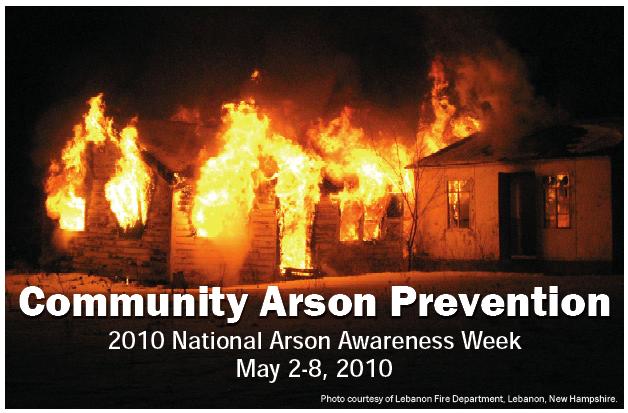
Arson Awareness Week May 2-8, 2010

"Community Arson Prevention"

The United States Fire Administration (USFA) announces this year’s Arson Awareness Week theme – Community Arson Prevention. The USFA will partner with the International Association of Arson Investigators, Bureau of Alcohol, Tobacco, Firearms and Explosives (ATF), USAonWatch, National Association of State Fire Marshals, National Volunteer Fire Council, and the Insurance Committee for Arson Control.

The goal for this year’s Arson Awareness Week, which takes place May 2 – 8, 2010, is to focus attention on the horrific crime of arson and provide communities with tools and strategies to combat arson in their neighborhoods, businesses, schools, and places of worship.

According to the USFA's National Fire Incident Reporting System (NFIRS) data and the National Fire Protection Association (NFPA), an estimated average of 316,600 intentional fires are reported to fire departments in the United States each year causing injuries to 7,825 firefighters and civilians. In 2006, ten firefighters died as a result of arson. In addition to needless injury and death, an estimated $1.1 billion in direct property loss occurs annually.

Arson robs communities of its valuable assets – lives and property. Arson destroys more than buildings: it can devastate a community resulting in the decline of the neighborhood through increased insurance premiums, loss of business revenue, and a decrease in property values.

Communities can develop a Watch Program, partnering with their local fire department, law enforcement, insurance providers, business leaders, churches, and local community groups. Neighborhoods can reduce the likelihood of arson occurring by promoting neighborhood watches and educate people about recognizing and reporting unusual activities along with implementing improved internal and external security for homes and businesses.

A community Arson Watch Program can put the neigh­bor back into neighborhood by creating a sense of coop­eration. It brings the fire service, law enforcement, and citizens together to reduce the crime of arson.

"Reproduced from USFA's Web site, © USFA (2010)."


(The usual disclaimers: I am not a journalist; this is a blog that expresses an outlook and is not conclusive in any shape or manner.)

Search The Internet